Why get a Substrate & RMR test? An insight into your fueling
How much should I fuel during my activity?
How many calories did I burn during my activity?
What about outside of training?
In any calorie tracker, there are assumptions being made based on the metrics available. A quick but rigorous visit to your local laboratory can answer these questions with far more accuracy than any estimation-based tracker.
How much should I fuel during my activity?
How many calories did I burn during my activity?
What about outside of training?
In any calorie tracker, there are assumptions being made based on the metrics available. A quick but rigorous visit to your local laboratory can answer these questions with far more accuracy than any estimation-based tracker.
A substrate test answers questions around fueling during an activity and total calories burned during an activity
“Well, Strava says I just burned 2400kcal; I guess that means I’ll order a large.”
In cycling, with the use of a power meter, power, in watts, is converted to kilojoules, which are then used to estimate kilocalories. This estimation assumes your mechanical efficiency. Without a power meter, kilojoules are estimated based on the combination of available metrics such as your weight, pace, and heart rate. From least to most accurate are pace & weight, additional use of a heart rate monitor, and, in cycling, a power meter (Note: Running power meters do not record real wattage as a bicycle one does, so their wattage values are only estimates).
We can think of mechanical efficiency as the percentage of the calories burned that are used to generate external mechanical work (in this case, power measured by the bike). Another way to put it is: for every calorie spent, how much power did I produce? Furthermore, each individual’s mechanical efficiency can vary significantly; in scientific literature, some were measured at 18% and others at 26%. A typical value used in estimations ranges from 22 to 24%.
This is where a substrate test comes in; a substrate test, also known as a metabolic efficiency test, tells us the amount and combination of substances (namely, carbohydrates and fats) utilized at given efforts. We can then calculate our mechanical efficiency at these efforts and also very accurately estimate what we burned in a given workout. (Note: It is still an estimation, as our bodies are constantly changing - there can be variation in test results even if you test back-to-back days. That being said, it is more accurate than assuming).
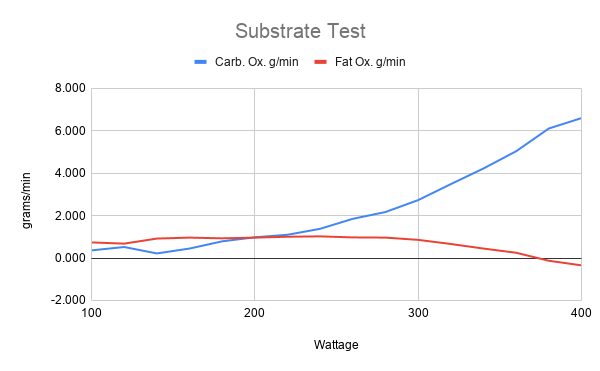
With this information, we can track our mechanical efficiency and substrate usage over time. As we get fitter or improve our biomechanics, we become more efficient. Our substrate usage can be changed based on training goals; that being said, typically, we want to see a higher fat usage at most efforts, and more carbs for harder efforts. We can also be sure we are providing our bodies with enough carbs during an activity to maintain the effort level. (Though carb uptake is a conversation for a different post).
Additionally, we can use a substrate test to calculate our training zones from a metabolic perspective. That will also be discussed in another post.
An RMR test fills in (almost) the rest
“Sorry, I have to lie here all day or else I’m just guessing.”
If we want to calculate our TDEE (total daily energy expenditure), we need four things:
RMR (Resting Metabolic Rate) - calories spent on basic bodily functions to live
Non-Exercise Activity Thermogenesis - calories spent on daily tasks
Exercise Activity Thermogenesis - calories spent on conscious exercise
Thermic Effect of Food - calories spent on digesting
The substrate test gives us the exercise portion, and the RMR test gives us the, well, the RMR part (the amount of substances we use at a fasted resting state). That leaves just two: calories spent on daily tasks and calories spent on digesting. Now, of course, no one only works out, then lies down for the other hours of the day fasted, so we have to estimate the last two pieces — an exact number is impossible, but there are multiple ways to come to an estimate.
Two simple ways would be to utilize wearable technology (a decent option if it tracks heart rate, though it can be hard to separate exercise calories) or multiplying RMR by a constant based on activity level (1.2 → 1.4, desk job/<5000 non-exercise step count → physically active job/>10000 non-exercise step count). My recommendation would be to pick one and stick with it. This way, if there is a fueling issue, we have a constant that we can adjust rather than bouncing between variables.
There is still a small caveat, even with all four pieces: EPOC (Excess Post-Exercise Oxygen Consumption). After an intense workout, as our body recovers, it increases oxygen consumption and our RMR. This is not a factor in a typical day and can mostly be ignored. As a coach, if the goal is to drop weight, I would still prefer an athlete to slightly over-fuel on intense workout days, as the risks of too large of a deficit outweigh the risks of being slightly over our weight goal.
Substrate + RMR
Together, we can finally have an accurate estimate of our total daily calories burned. When we calculate our TDEE, a common mistake is to use the full 24hrs of your RMR plus your exercise calories. This is incorrect and can lead to frustration if maintaining or dropping weight is the goal. Therefore, the equation would look like:
(RMR * Activity Level Multiplier) * % of day not exercising + Exercise Calories from substrate test = TDEE
A desk job worker with a 2-hour workout may have a formula as below:
(1876 × 1.2) * (22/24) + 1634 = 3698 calories burned for the day.
Now, we can confidently say our daily calorie expenditure and adjust our fueling strategy, in conjunction with our goals, accordingly.
(Note: alternatively, you could calculate your RMR per minute, multiply that by your exercise time, and subtract the product from your total exercise calories, then add the sum to your RMR * Multiplier. Both methods are acceptable).
With a much more accurate TDEE, we can more safely adjust our calorie intake
intervals.icu integration
Anyone who utilizes Intervals.icu knows how amazing the software is. That being said, their calorie and carb expenditures are not great. To solve that, I have created custom fields you can add to your own account. These fields utilize your substrate test to provide you with the number of calories, grams of carbs, and grams of fat, spent during a ride. Read more on how to do it here.